Bank reconciliation definition
/What is a Bank Reconciliation?
A bank reconciliation compares the cash balance in an entity’s accounting records with the corresponding balance on the bank statement. Its purpose is to identify differences and record any necessary adjustments. Differences commonly arise from outstanding checks, deposits in transit, bank service charges, overdraft penalties, interest, and returned deposits for insufficient funds. Because some transactions are recorded by the entity before the bank, while others are recorded by the bank first, the two ending cash balances rarely agree before the reconciliation is completed.

When to Conduct a Bank Reconciliation
You should complete a bank reconciliation at regular intervals for all bank accounts, to ensure that your cash records are correct. Otherwise, you may find that cash balances are much lower than expected, resulting in bounced checks or overdraft fees. A bank reconciliation will also detect some types of fraud after the fact; this information can be used to design better controls over the receipt and payment of cash.
Here are some options for when to conduct a bank reconciliation:
Month-end bank reconciliation. At a minimum, conduct a bank reconciliation shortly after the end of each month, when the bank sends you a bank statement containing the bank's beginning cash balance, transactions during the month, and ending cash balance.
Daily bank reconciliation. It is even better to conduct a bank reconciliation every day, based on the bank's month-to-date information, which should be accessible on the bank's web site. By completing a bank reconciliation every day, you can spot and correct problems immediately. In particular, a daily reconciliation will highlight any ACH debits from the account that you did not authorize; you can then install a debit block on the account to prevent these ACH debits from being used to withdraw funds from the account without your permission.
If there is so little activity in a bank account that there really is no need for a periodic bank reconciliation, you should question why the account even exists. It may be better to terminate the account and roll any residual funds into a more active account. By doing so, it may be easier to invest the residual funds, as well as to monitor the status of the investment.
Bank Reconciliation Process Flow
The essential process flow for a bank reconciliation is to start with the bank's ending cash balance, add to it any deposits in transit from the company to the bank, subtract any checks that have not yet cleared the bank, and either add or deduct any other items. Then, go to the company's ending cash balance and deduct from it any bank service fees, NSF checks and penalties, and add to it any interest earned. At the end of this process, the adjusted bank balance should equal the company's ending adjusted cash balance.
Bank Reconciliation Terminology
The key terms to be aware of when dealing with a bank reconciliation are:
Deposit in transit. This is cash or checks recorded by an entity but not yet recorded by its bank. At month-end, it becomes a reconciling item because it does not appear on the bank statement. Delays can result from late deposits, mailed deposits, or deposits not yet delivered to the bank.
Outstanding check. A check payment that has been recorded by the issuing entity, but which has not yet cleared its bank account as a deduction from cash. If it has not yet cleared the bank by the end of the month, it does not appear on the month-end bank statement, and so is a reconciling item in the month-end bank reconciliation.
NSF check. A check that was not honored by the bank of the entity issuing the check, on the grounds that the entity's bank account does not contain sufficient funds. NSF is an acronym for "not sufficient funds." The entity attempting to cash an NSF check may be charged a processing fee by its bank. The entity issuing an NSF check will certainly be charged a fee by its bank.
Bank Reconciliation Procedure
The following bank reconciliation procedure assumes that you are creating the bank reconciliation in an accounting software package, which makes the reconciliation process easier:
Enter the bank reconciliation software module. A listing of uncleared checks and uncleared deposits will appear.
Check off in the bank reconciliation module all checks that are listed on the bank statement as having cleared the bank.
Check off in the bank reconciliation module all deposits that are listed on the bank statement as having cleared the bank.
Enter as expenses all bank charges appearing on the bank statement, and which have not already been recorded in the company's records.
Enter the ending balance on the bank statement. If the book balance and bank balance match, then post all changes recorded in the bank reconciliation and close the module. If the balances do not match, then continue reviewing the bank reconciliation for additional reconciling items. Look for the following items:
Checks recorded in the bank records at a different amount from what is recorded in the company's records.
Deposits recorded in the bank records at a different amount from what is recorded in the company's records.
Checks recorded in the bank records that are not recorded at all in the company's records.
Deposits recorded in the bank records that are not recorded at all in the company's records.
Inbound wire transfers from which a lifting fee has been extracted.
Problems with Bank Reconciliations
There are several problems that continually arise as part of the bank reconciliation, and which you should be aware of. They are:
Uncleared checks that continue to not be presented. There will be a residual number of checks that either are not presented to the bank for payment for a long time, or which are never presented for payment. In the short term, you should treat them in the same manner as any other uncleared checks - just keep them in the uncleared checks listing in your accounting software, so they will be an ongoing reconciling item. In the long term, you should contact the payee to see if they ever received the check; you will likely need to void the old check and issue them a new one.
Checks clear the bank after having been voided. If a payee cashes an original check after a replacement has been issued, the bank should reject it if the original was voided with the bank. Otherwise, record the payment by crediting cash and debiting the appropriate expense, asset, or liability account. Immediately void any outstanding replacement check. If both checks are cashed, the company must seek repayment of the duplicate amount from the payee.
Deposited checks are returned. There are cases where the bank will refuse to deposit a check, usually because it is drawn on a bank account located in another country. In this case, you must reverse the original entry related to that deposit, which will be a credit to the cash account to reduce the cash balance, with a corresponding debit (increase) in the accounts receivable account.
Another possibility that may be causing problems is that the dates covered by the bank statement have changed, so that some items are included or excluded. This situation should only arise if someone at the company requested the bank to alter the closing date for the company's bank account.
Example of a Bank Reconciliation
ABC International is closing its books for the month ended April 30. ABC's controller must prepare a bank reconciliation based on the following issues:
The bank statement contains an ending bank balance of $320,000.
The bank statement contains a $200 check printing charge for new checks that the company ordered.
The bank statement contains a $150 service charge for operating the bank account.
The bank statement rejects a deposit of $500 due to not sufficient funds, and charges the company a $10 fee associated with the rejection.
The bank statement contains interest income of $30.
ABC issued $80,000 of checks that have not yet cleared the bank.
ABC deposited $25,000 of checks at month-end that were not deposited in time to appear on the bank statement.
The controller creates the following reconciliation:
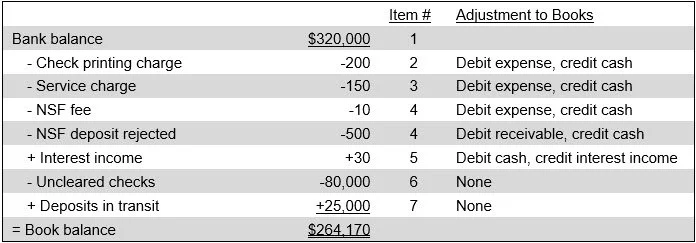
Bank Reconciliation Statement
When the bank reconciliation process is complete, you should be able to print a report through your accounting software that shows the bank and book balances, the identified differences between the two (mostly uncleared checks), and any remaining unreconciled difference. Retain a copy of this report for each month. The auditors will want to see it as part of their year-end audit. The format of the report will vary by software package; a simplistic layout is:

Bank Reconciliation FAQs
What documentation should support a bank reconciliation?
A bank reconciliation should be supported by the bank statement, general ledger cash balance, outstanding check listing, deposit records, bank notices, and documentation for reconciling items such as service charges, interest, transfers, returned checks, and errors. Evidence should also show who prepared and reviewed the reconciliation.
What audit risks are associated with bank reconciliations?
Audit risks associated with bank reconciliations include stale or unresolved reconciling items that may conceal errors or misstatements. Additional risks arise from improper cutoff, unauthorized cash transactions, or failure to record bank activity timely. Weak segregation of duties or lack of independent review increases the risk of fraud and management override.
Related Articles
How to Reconcile a Bank Statement